Dryer Drum Won’t Spin? Here’s Every Cause and Fix
When your dryer drum won’t spin — you can hear the motor running, the machine heats up, but the drum sits completely still — your laundry just sits in a hot, stationary chamber and comes out as wet as it went in. A drum that doesn’t spin is a distinct problem from a dryer that […]
 5 min read
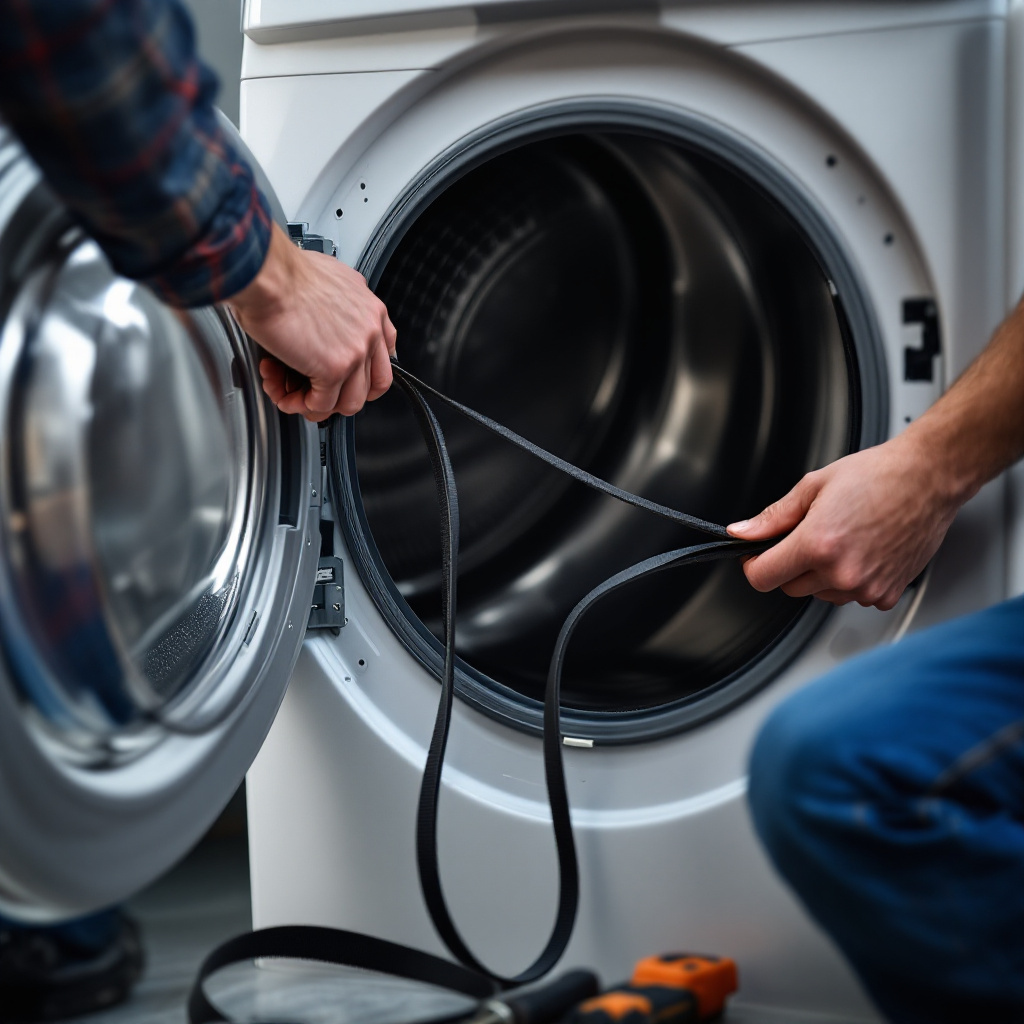
When your dryer drum won’t spin — you can hear the motor running, the machine heats up, but the drum sits completely still — your laundry just sits in a hot, stationary chamber and comes out as wet as it went in. A drum that doesn’t spin is a distinct problem from a dryer that doesn’t heat or a dryer that makes noise. It points specifically to the mechanical drive system: the belt, the motor, the idler pulley, or the start switch.
This guide covers every cause of a non-spinning dryer drum in order from most to least common.
1. Broken Drive Belt
This is by far the most common cause of a dryer drum that won’t turn. The drive belt is a long, thin rubber belt that wraps around the drum, over the idler pulley, and around the motor pulley. It’s the mechanical connection between the motor and the drum. When it breaks — which it eventually does on every dryer — the motor runs freely but the drum doesn’t move at all.
How to confirm a broken belt:
- Open the dryer door and try to spin the drum by hand. On a functioning machine, you’ll feel significant resistance from the belt tension. On a machine with a broken belt, the drum spins freely with almost no resistance.
- If the drum spins freely, the belt is broken.
Replacing the belt:
- Access requires removing the front panel (on most models) or the rear panel.
- The new belt routes around the drum, under the idler pulley (which provides tension), and around the small motor pulley at the base.
- Drive belts cost $10–$25 and replacing them is a manageable mid-level DIY repair.
- While the machine is open, inspect the idler pulley and drum rollers — if the belt broke from age, these are often ready for replacement at the same time.
Our article on why your dryer is squeaking covers the full mechanical drive system in detail — useful context if you’re replacing multiple components at once.
2. Failed Idler Pulley
The idler pulley is a spring-loaded wheel that keeps tension on the drive belt. When its bearing seizes, the pulley locks up — and a locked pulley either snaps the belt (see above) or prevents the belt from moving even if it’s intact. A seized idler pulley often produces a burning rubber smell before the belt snaps.
- With the belt removed, spin the idler pulley by hand — it should rotate smoothly with no roughness or resistance.
- A seized idler pulley is inexpensive ($15–$30) and should always be replaced at the same time as the belt.
3. Worn Drum Rollers
The drum sits on support rollers (usually two at the rear, sometimes two at the front as well). When these rollers seize or wear flat, the drum can’t rotate even with the belt intact — the motor strains, the belt may slip, and the drum barely moves or doesn’t move at all. In severe cases, the motor’s thermal overload trips from the strain and the dryer shuts off entirely.
- With the belt off, try spinning each roller by hand — they should spin freely and smoothly.
- Drum rollers should be replaced as a complete set — if one is seized, the others are usually close behind.
4. Failed Drive Motor
If the belt is intact, the idler pulley spins freely, and the rollers move smoothly — but the drum still doesn’t turn — the motor may have failed. A motor that’s seized or has a failed start winding will hum but not develop enough torque to move the drum.
- A motor that hums but doesn’t turn the drum (and is working against a correctly tensioned belt) indicates a motor fault.
- On some machines, a clogged blower wheel puts back-pressure on the motor that prevents it from reaching operating speed — check that the blower wheel (the fan that moves air through the dryer) spins freely and has no lint blockage.
- Motor replacement is the most expensive drum-related repair. On older dryers, evaluate replacement value versus repair cost. Our repair vs. replace cost guide helps frame this decision.
5. Faulty Door Switch
Most dryers cut power to the motor (and drum rotation) when the door is open — a safety interlock. If the door switch fails in the “open” position, the drum won’t spin even with the door closed.
- Test by pressing the door switch manually with the door open — if the drum starts turning, the switch is working but not being depressed by the door mechanism.
- If pressing the switch doesn’t start the drum, test with a multimeter — the switch should show continuity when pressed.
- Door switch replacement is inexpensive and easy on most models.
6. Thermal Fuse Blown
On some dryer models, a blown thermal fuse cuts power to the motor rather than just the heating element. In this case, neither the drum nor the heater will work — the machine appears completely dead or runs with just the drum motor inactive.
- A blown thermal fuse requires replacement — it cannot be reset.
- Always investigate why the fuse blew (usually a clogged vent causing overheating) before replacing it, or the replacement fuse will blow again shortly after.
- Our article on dryer not heating — parts to check covers the full electrical safety system including the thermal fuse.
When to Call a Professional
Belt replacement, idler pulley replacement, and roller replacement are mid-level DIY repairs that are well within reach for a mechanically inclined homeowner. Motor replacement and control board issues are best left to a technician.
North Vancouver Appliances handles dryer mechanical repairs quickly across North Vancouver and the North Shore. Visit our dryer repair page to book a visit.